
01
Inputs
Where context enters the workflow.
- Requests
- Notes
- Systems
- Conversation notes
- Reports
AI Workflow Audit
NORTIQ maps how the work runs today, where signal gets lost, and where AI can create practical leverage.
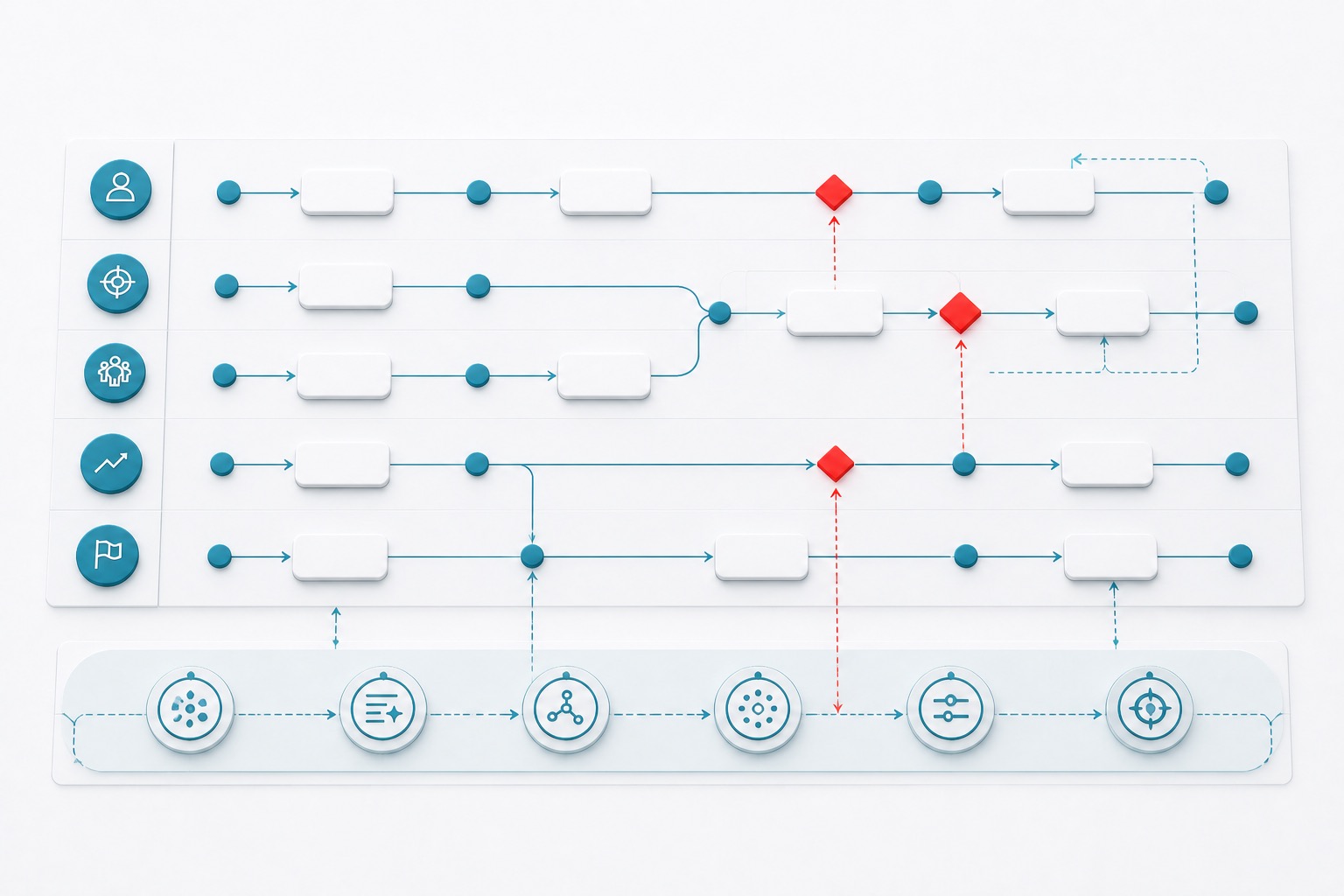
Map the current workflow before deciding what AI should do.
The AI Workflow Audit maps inputs, workflow steps, decision points, friction, AI support opportunities, and human review points before recommending what should change.
Map the current state before deciding what AI should do.
Where context enters the workflow.
How work actually moves today.
Where judgment, approval, or prioritization happens.
Where signal gets lost or work slows down.
Where AI may support the work.
Where judgment stays accountable.
How the work happens today.
Who decides, where judgment is required, and where decisions slow down.
Where context enters, duplicates, disappears, or becomes useful.
What systems, files, reports, and AI experiments are already in play.
Where AI can support the workflow, and where structure needs to come first.
What ownership, cadence, review, and implementation sequence are needed.
The goal is to understand the work well enough to decide what should be redesigned, what should be supported by AI, what should stay human, and what should wait.
The audit creates enough clarity to choose the next practical test.
How the work runs today.
Where AI can and cannot help.
What workflow, cadence, and ownership need to change.
What to test, build, or implement next.
Four executive outputs, not a theoretical AI strategy deck.
Where the work slows down and who owns it.
Where AI can support synthesis, triage, drafting, coaching, or review.
What needs ownership, cadence, data, or human review.
The workflow, agent, GTM OS path, or implementation step worth testing.
The audit is meant to clarify where AI belongs before build decisions get made.
An AI Workflow Audit maps how work runs today, where friction appears, and where AI can support the workflow without removing human accountability.
The audit produces a workflow map, AI fit map, adoption risk view, and a practical first operating move.
No. The audit starts with the work itself, then decides whether AI, agents, workflow redesign, GTM OS, or another operating move is useful.
Founders and operators should book it when AI interest is real, but the use cases, workflow, data shape, and adoption path are still unclear.
Use these accordions when you want the detail behind the diagnostic.
Useful when the founder or senior operator is still the point where too many decisions, approvals, and context checks converge.
Useful when pipeline, customer conversations, CRM context, or deal execution creates scattered signal and founder-dependent decisions.
Useful when customer work, support, onboarding, internal operations, or delivery depends on repeated manual coordination.
Useful when AI tools exist but the team does not have the rituals, ownership, or feedback loops required to use them consistently.
AI is more useful when the same kind of work happens repeatedly and can be structured.
The workflow has usable source material such as notes, system records, forms, documents, reports, or structured team inputs.
The team can explain what decisions are made, who makes them, and where review is needed.
The work connects to meetings, reviews, handoffs, coaching, reporting, or recurring operating rituals.
AI supports preparation, review, synthesis, routing, or drafting without replacing accountability.
The workflow becomes easier to run, easier to inspect, or easier to improve.
Pick a 30-minute time in Calendly. Use the conversation to identify the workflow, decision path, or adoption problem worth mapping first.